
Comparative Crop Resilience to the Winter 2026 Florida Freeze: Perennial Mortality in Conventional Commodities Versus Regenerative Survival in Commercial Bamboo
- OnlyMoso USA

- Jun 24
- 17 min read
Plain-Language Summary
In early 2026, two back-to-back winter storms brought Florida its hardest freeze in more than fifteen years, causing roughly $3.17 billion in crop damage statewide. For many of Florida's signature crops, the freeze did lasting harm. It killed citrus trees outright, forced growers to cut blueberry bushes to the ground, and set sugarcane back for years. Bamboo grown in the same area behaved very differently. Although the cold killed all of the bamboo's above-ground growth, the plants themselves survived — by grower counts, fewer than one in four thousand died (7 of more than 29,000 plants across twelve documented operations) — because the living core of a bamboo plant sits underground, protected by the soil, and simply grows back. The trade-off is that those groves will produce little or no harvest this season while they regrow. In short, the freeze cost the bamboo growers a season's harvest, but it cost the citrus and blueberry growers the plants themselves — and that difference is what this paper examines.
Key Terms
This paper uses some agricultural terms that may be unfamiliar to a general reader. The most important are defined here.
• Perennial crop — a plant that lives and produces for many years, such as a tree, vine, bush, or cane; the opposite of an annual crop, which is replanted every year.
• USDA hardiness zone — a standard rating of how cold an area typically gets in winter, used to judge which plants can survive there. The two zones relevant here, 9b and 10a, differ by about 5°F.
• Average annual extreme minimum temperature — the coldest temperature a place can normally expect in a typical year; it is the basis for hardiness-zone ratings.
• Culm — the woody cane or stem of a bamboo plant (the visible "pole").
• Rhizome — the underground stem-and-root mass of a bamboo clump, where the plant stores its energy and from which it regrows.
• Clumping bamboo — a bamboo that grows in tight, slowly expanding clusters rather than spreading by runners; Dendrocalamus asper is one.
• Top-kill — the death of all of a plant's above-ground growth while its roots and crown survive and can regrow.
• Ratoon crop — the regrowth that springs back from the same roots after a crop, such as sugarcane, is cut.
• Citrus greening (HLB) — a bacterial disease, unrelated to the freeze, that has been killing Florida citrus trees for years.
Abstract
The winter storms of 2026 (Ezra, December 30, 2025 – January 1, 2026; Gianna, January 26 – February 4, 2026) produced one of the most damaging freeze events in Florida's recorded agricultural history, with preliminary statewide losses estimated by the Florida Department of Agriculture and Consumer Services (FDACS) at approximately $3.17 billion [1, 3]. This analysis distinguishes between two categories of freeze loss — forfeited harvest versus destruction of productive plant capital — and examines how that distinction separates Florida's conventional perennial commodities from commercial bamboo grown in the same affected region. Official data indicate that citrus, blueberry, and sugarcane operations sustained significant plant-level mortality and multi-year productivity impairment [1, 2, 4, 5, 6]. Grower-reported field assessments from south-central ridge bamboo plantings indicate documented plant mortality of approximately 0.02 percent (7 of 29,239 plants across 12 operations) despite complete loss of above-ground growth, attributable to the survival of insulated below-ground rhizome and clump structures [13, 14, 17]. The analysis concludes that the principal resilience advantage of bamboo in this event was the preservation and self-regeneration of productive capital, at the cost of a single deferred harvest season. Limitations regarding the preliminary and partly grower-sourced nature of the data are addressed.
Introduction
Freeze events impose qualitatively different costs on annual and perennial cropping systems. For an annual crop, freeze damage forfeits a single season's production. For a perennial crop, freeze damage can destroy the plant itself, eliminating the multi-year capital investment required to bring that plant to productive maturity and committing the operation to replanting and re-establishment. This distinction is central to evaluating agricultural resilience under increasing climate volatility.
This paper applies that framework to the Winter 2026 Florida freeze. It compares the documented impacts on three of Florida's major perennial commodities — citrus, blueberry, and sugarcane — with the reported response of commercial bamboo (Dendrocalamus asper) plantings located in the same affected counties. The objective is not to characterize bamboo as freeze-tolerant, which the data do not support, but to assess whether its regenerative growth habit confers a measurable capital-preservation advantage relative to conventional perennials under identical freeze conditions.
Background: The Winter 2026 Freeze Events
Two sequential winter storms affected Florida in the opening weeks of 2026. FDACS attributes the agricultural damage to Winter Storm Ezra (December 30, 2025 – January 1, 2026) and Winter Storm Gianna (January 26 – February 4, 2026) [1, 3]. Meteorological reporting characterized the associated cold outbreak as the most severe in more than fifteen years, driven by Arctic air originating approximately 4,000 miles to the north [8].
The event was geographically near-comprehensive. FDACS reports that 66 of Florida's 67 counties experienced multiple hours of sub-freezing temperatures, with only Monroe County (the Florida Keys) unaffected [1, 3]; the statewide extent is shown in Figure 1. Numerous daily and monthly low-temperature records were broken across the state, including a record low of 23°F recorded at Winter Haven in the central ridge [9].

Data and Sources
Conventional-commodity loss figures in this analysis are drawn from the FDACS preliminary damage assessment ("Winter Storms Ezra and Gianna — Preliminary Estimates of Damage to Florida Agriculture") as reported through primary and secondary outlets [1, 2, 3, 4, 5], and from a U.S. Department of Agriculture Risk Management Agency (RMA) claims advisory specific to blueberries [6]. Meteorological data are drawn from contemporaneous weather reporting [8, 9] and a historical UF/IFAS extension record for regional context [10]. The botanical and biological characterization of Dendrocalamus asper — including its taxonomy, clump architecture, agro-climatic tolerances, and documented frost limit — is drawn primarily from the peer-reviewed review of Mustafa et al. [14] and the INBAR technical manuals for clumping-bamboo management and biomass/carbon assessment [17, 18]. USDA plant-hardiness zones for the planting footprint are taken from the authoritative 2023 USDA Plant Hardiness Zone Map (PRISM Climate Group, Oregon State University) [19]; the horticultural suitability of D. asper within those zones, and the frost-susceptibility of new shoots, are drawn from grower and nursery sources [12, 13, 15].
Bamboo plant-survival and recovery figures are grower-reported field assessments from operations within the affected region; they are not derived from a published government survey or peer-reviewed study. This sourcing distinction is maintained throughout and explicitly addressed in the Limitations section below.
Findings
Aggregate agricultural losses
FDACS placed total preliminary statewide agricultural losses at more than $3.1 billion, with a working aggregate of approximately $3.17 billion across all commodities [1, 3]. The commodity-level breakdown released by the agency is reproduced in Table 1 and charted in Figure 2 [1]:
Commodity | Estimated loss (USD) |
Sugarcane | 1,152,122,146 |
Citrus | 674,660,336 |
Strawberries | 306,965,897 |
Sweet corn | 255,363,251 |
Greenhouse & nursery | 240,000,000 |
Tomatoes | 164,273,849 |
Bell peppers | 108,380,389 |
Potatoes | 79,065,000 |
Blueberries | 78,512,400 |
Watermelons | 65,437,343 |
Squash | 24,522,275 |
Cabbage | 21,800,280 |
Table 1. Preliminary statewide agricultural losses by commodity, as reported by FDACS [1].

A USDA disaster declaration followed the FDACS assessment [1].
Perennial mortality and capital loss in conventional commodities
Citrus. FDACS attributed $327.38 million of total citrus losses to tree damage and estimated outright tree loss at approximately 15 percent of trees within affected areas, with roughly 80 percent of the state's citrus acreage significantly affected [1, 5]. The agency further projected a multi-year average productivity reduction of approximately 27 percent per year, followed by a recovery to pre-event production levels [4]. These impacts compounded a pre-existing long-term decline in Florida citrus associated with citrus greening (HLB) and an aging tree inventory [16].
Blueberry. The USDA RMA issued a formal claims advisory describing the freeze damage to blueberries in Florida and Georgia as catastrophic, with recommended grower responses including removal of dead tissue and, in severe cases, mowing entire stands to the ground to promote regrowth and protect future-year production [6]. FDACS estimated approximately 90 percent crop loss for blueberries [1].
Sugarcane. As the largest single commodity loss, sugarcane sustained an estimated 35 percent current-season production loss (approximately $576 million), with an approximately equal value in projected future-season losses [2, 4]. FDACS attributes the future-season component to the perennial-grass growth habit, in which freeze injury affects both the standing crop and the ratoon crop regrowing for the subsequent season [2].
Across all three commodities, the documented damage extended beyond forfeited harvest to plant-level mortality or impairment, entailing replanting, re-establishment, or multi-year yield reduction.
Bamboo response in the south-central ridge
Commercial bamboo plantings in this analysis are concentrated in Hardee, Highlands, Polk, and Hendry counties — including Zolfo Springs, Wauchula, Sebring, Lake Placid, Frostproof, Fort Meade, Alturas, and LaBelle. This footprint lies within Florida's historic citrus belt [11] and is climatically equivalent to the conventional perennial operations described above. Instrument data from the Florida Automated Weather Network (FAWN) confirm the freeze severity across the footprint (Table 2; Figures 3 and 4): station minima during the event ranged from 20.9°F at Tiger Creek (Polk County) and 21.9°F at Okahumpka (Lake County) to 28.2°F at Sebring (Highlands County), with the Hardee, Polk, Glades, and Lake County stations recording lows near 21–25°F. The Lake Alfred station, adjacent to Winter Haven, recorded 22.6°F, corroborating the regional record noted in contemporaneous reporting [9]. The lowest readings occurred in the pre-dawn hours of February 1–2, 2026 — within the Winter Storm Gianna window — and rebounded above freezing by late morning, indicating a short-duration radiational freeze [21]. Per the 2023 USDA Plant Hardiness Zone Map, these sites span zones 9b–10a [19].
FAWN station | County | Event low (°F) | Date | Hrs ≤32°F (Dec–Feb) |
Tiger Creek | Polk | 20.9 | Feb 2 | 50.25 |
Okahumpka | Lake | 21.9 | Feb 1 | 64.0 |
Palmdale | Glades | 22.6 | Feb 2 | 48.25 |
Lake Alfred | Polk | 22.6 | Feb 1 | 25.0 |
Ona | Hardee | 22.7 | Feb 2 | 58.25 |
Babson Park | Polk | 24.2 | Feb 1 | 11.25 |
Fort Pierce | St. Lucie | 25.9 | Feb 1 | 19.25 |
St. Lucie West | St. Lucie | 26.0 | Feb 2 | 32.5 |
Clewiston | Hendry | 26.7 | Feb 1 | 9.0 |
Sebring | Highlands | 28.2 | Feb 1 | 6.25 |
Table 2. Florida Automated Weather Network (FAWN) station temperatures during the Winter 2026 freeze, for stations covering the bamboo footprint. "Event low" is the lowest 2 m air temperature recorded; the final column is total hours at or below 32°F across the December 2025–February 2026 winter [21].


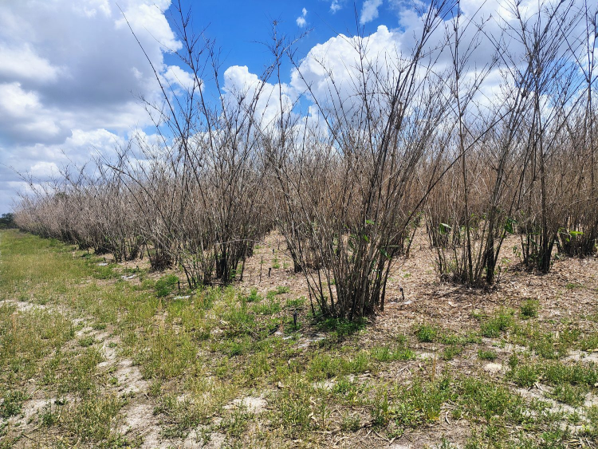
A field assessment of 12 commercial Asper operations — together comprising roughly 89 acres and 29,232 currently standing plants — recorded total plant loss of 7 plants, a mortality rate of approximately 0.02 percent, with 9 of the 12 operations reporting no plant loss at all, despite complete (approximately 100 percent) loss of above-ground growth at affected sites. Affected operations report being in full recovery, regenerating from surviving below-ground structures, with the expectation of a limited or negligible shoot harvest in the current season as groves reallocate resources to canopy regrowth.
Grower field assessment data
These survival figures are based on a field assessment of 12 commercial D. asper operations, compiled in mid-2026 (Table 3). The operations consist of established plantings, 2.6 to 5.6 years old at the time of the freeze, totaling roughly 89 acres. Ten lie within the four-county core footprint (Hardee, Highlands, Polk, and Hendry); two further operations — in Indian River County to the east and Lake County to the north — extend the assessment to six counties. Across 29,239 plants, the total recorded loss was 7 (approximately 0.02 percent), and 9 of the 12 operations recorded none. The dataset reflects current standing plant counts following the freeze; it documents survival and mortality but does not independently isolate the cause of the few recorded losses, nor does it quantify canopy (top-kill) damage or recovery, which remain grower-reported observations [20].
Operation | County | Acres | Age (yr) | Plants | Lost |
1 | Hardee | 9.5 | 4.8 | 3,774 | 0 |
2 | Hardee | 5 | 3.5 | 1,151 | 2 |
3 | Hardee | 2.5 | 4.6 | 1,000 | 0 |
4 | Hendry | — | 3.6 | 1,680 | 0 |
5 | Highlands | 10 | 5.4 | 4,000 | 0 |
6 | Polk | 20 | 4.8 | 5,133 | 0 |
7 | Polk | 11.3 | 4.7 | 4,438 | 0 |
8 | Polk | 5 | 5.6 | 2,000 | 0 |
9 | Polk | 8 | 3.8 | 2,003 | 2 |
10 | Polk | 10 | 5.5 | 1,980 | 0 |
11 | Indian River | 5 | 2.6 | 1,098 | 0 |
12 | Lake | 3 | 4.6 | 975 | 3 |
Total | 6 counties | 89.3 | — | 29,232 | 7 |
Table 3. Field assessment of 12 commercial Dendrocalamus asper operations following the Winter 2026 freeze. Operation identities are anonymized; plant counts are current standing plants as of mid-2026
Discussion
Mechanism of survival
The bamboo grown commercially for shoots in this region is predominantly Dendrocalamus asper. As characterized in the peer-reviewed review by Mustafa et al. [14], D. asper — commonly termed "sweet bamboo" — is a giant, multipurpose tropical clumping (sympodial) bamboo native to India and Southeast Asia, reaching roughly 15–30 m in height across published descriptions [14, 17], whose tender young shoots are regarded as among the finest of the tropical Asiatic bamboos and have since been introduced to other tropical and subtropical regions, including Florida. As a tropical-to-subtropical clumping bamboo, it is not cold-hardy. The INBAR management manual for clumping bamboo records that D. asper withstands frost only to about −4°C (approximately 25°F) [17] — a limit that coincides with the cold boundary of USDA zone 9b, defined by an average annual extreme minimum temperature of 25–30°F. Per the 2023 USDA Plant Hardiness Zone Map (1991–2020 normals), the planting footprint spans zones 9b and 10a: the lower-lying western sites in Hardee County and parts of Polk fall in 9b, while much of the Lake Wales Ridge in Highlands County and the Hendry County site at LaBelle fall in the warmer 10a [19]. Horticultural guidance identifies zones 10–11 as the reliable farm range for D. asper [12]. Critically, the station-recorded lows of roughly 21–28°F (≈ −6 to −2°C; Table 2) were below the average annual extreme minimum for both zones present in the footprint — below the 9b floor of 25°F at most stations and below the 10a floor of 30°F at every station — so complete above-ground top-kill was the expected outcome under these conditions, not an anomalous one.
Plant survival is attributable to the below-ground clump structure rather than to the cold tolerance of the culms (Figure 5). The dense root and rhizome mass at the base of a clumping bamboo retains the plant's energy reserves and is insulated by soil, which remains warmer than ambient air during a short-duration freeze. Horticultural sources document that this root mass frequently survives temperatures sufficient to kill culms to ground level, subsequently producing new shoots in the following growing season [13]. This regenerative capacity is consistent with the documented biology of the species: D. asper propagates vegetatively from its rhizome, clump, and culm cuttings, and standard harvesting practice deliberately retains mature tillers within the clump to sustain the stand across seasons [14]. INBAR classifies D. asper as a sympodial bamboo that forms tight clumps through short rhizomes, with the rhizome–root system reaching to roughly 60 cm in depth [17, 18] — well within the warmer soil profile that buffers against short-duration extremes in air temperature. Sustainable management of these clumps is itself premised on this regenerative architecture: standard practice retains young culms and an age-balanced clump structure precisely so that the stand renews itself from the rhizome each season [17]. The visible plant is destroyed while the living plant persists.
Field observations across the assessed operations indicate that this regeneration proceeds in two stages. The first new growth comes not from the rhizome but from the surviving culms themselves: the highest node on each top-killed culm that escaped freeze injury breaks bud and pushes out new branches and leaves. Because the freeze killed the culms nearly to their bases at most sites, this re-leafing occurred at or near ground level. It restores photosynthetic capacity on the surviving lower culm framework. It precedes the second stage, in which the rhizome system sends up entirely new shoots \u2014 the early return of foliage at the basal nodes helping to power that subsequent shoot production [20].

These dynamics are visible in the assessed stands. Figures 6 through 8 show the same operations during the freeze and its aftermath: top-killed culms left standing for two months, the lower culms and nodes that remained alive through the event, and the new branch and leaf growth re-flushing from those surviving nodes.


Deferred harvest versus destroyed capital
The findings support a clear categorical distinction. The conventional perennials examined sustained destruction of productive capital: dead citrus trees and mowed blueberry stands require replacement, and sugarcane sustained quantified future-season losses [1, 2, 4, 6]. The bamboo plantings, by contrast, sustained near-total loss of the current harvest while retaining the productive asset essentially intact, with regeneration proceeding from the plant's own reserves and without replanting.
This distinction also clarifies the cost borne by bamboo growers. Because the spring shoots are required to rebuild the canopy and replenish reserves — and because new shoots are themselves frost-susceptible [15] — harvesting in the recovery season would impair regeneration. The forfeited harvest is therefore the mechanism of recovery, not merely a consequence of damage.
Resilience implications
The broader context underscores the relevance of capital-preserving crop traits. Beyond the freeze, Florida recorded its most severe drought in two decades, and wildfires affected more than 54,600 hectares in the first half of 2026 [7]. Under conditions of elevated and compounding climate stress, a cropping system whose worst-case freeze outcome is a deferred harvest rather than stand destruction presents a materially different risk profile from that of perennials, whose freeze losses are realized as plant mortality and multi-year impairment.
The advantage identified here is specifically one of resilience and capital preservation, not of freeze tolerance or yield stability. The same event demonstrated that ridge-grown D. asper will fully top-kill and forfeit a production season under hard-freeze conditions, a freeze in which temperatures fell below the average annual extreme minimum of the footprint's 9b–10a hardiness zones [19]. The peer-reviewed literature is explicit on this point: owing to their perennial nature, bamboos encounter cold, drought, salinity, and high-temperature stress more frequently than other grasses, and natural tolerance currently remains the only available defense, as breeding for stress tolerance in D. asper remains underdeveloped [14]. The resilience documented in this analysis, therefore, rests on the species' intrinsic regenerative biology rather than on any cold-adapted or genetically improved germplasm.
Limitations
Several limitations apply. First, the FDACS figures are explicitly preliminary; refined estimates from the UF/IFAS Economic Impact Analysis Program producer survey may differ. Second, perennial freeze mortality is difficult to quantify in the immediate aftermath, as the full injury severity in woody perennials such as citrus often becomes apparent only after the subsequent spring flush; the 15 percent citrus tree loss figure is an early estimate subject to revision [16]. Third, the bamboo data occupy a middle tier of evidentiary strength: plant survival and mortality are now documented across 12 operations and roughly 29,000 plants (Table 3), but these remain grower-compiled counts rather than independently audited figures, the cause of the seven recorded losses is not isolated, and the canopy-damage and recovery observations are not yet quantified. These figures would be strengthened by independent verification and by structured recovery and harvest data over the coming season. Fourth, the bamboo footprint is not climatically uniform: per the 2023 USDA Plant Hardiness Zone Map, it spans zones 9b and 10a [19], so aggregated figures may obscure site-level variation in cold exposure, damage, and recovery between the cooler 9b sites (Hardee County and parts of Polk) and the warmer 10a sites (the Highlands ridge and LaBelle).
Conclusion
Under identical freeze conditions in a shared geographic region, Florida's conventional perennial commodities and commercial bamboo plantings exhibited categorically different loss profiles in Winter 2026. Conventional perennials sustained quantified plant mortality and multi-year productivity impairment, representing destruction of productive capital. Bamboo plantings sustained near-total above-ground loss but minimal plant mortality, representing a deferred harvest with preserved and self-regenerating capital. The mechanism is structural — survival of insulated below-ground clump tissue — rather than cold tolerance. Subject to the noted data limitations, the analysis supports characterizing bamboo as a more freeze-resilient cropping system, specifically in terms of capital preservation and autonomous regeneration.
What's Next for Growers
For operators whose groves were top-killed in the freeze, the management priority shifts from protection to recovery. The following principles follow from the regeneration biology described above and from standard clumping-bamboo practice [15, 17]; site-specific decisions should be confirmed with a qualified supplier or extension advisor.
Defer the harvest. The shoots that emerge in the recovery season are the plant's means of rebuilding its canopy and replenishing the rhizome reserves drawn down during regrowth. Because these new shoots are themselves frost-susceptible and are doing the work of recovery, harvesting them this season would slow the stand's return to full production. Most operators should expect a limited or negligible shoot harvest in the recovery year and treat that forfeited season as the cost of preserving the stand.
Leave the top-killed culms standing. The canes are killed above the lowest surviving node. Still, they are not necessarily dead to the ground: expect the highest undamaged node \u2014 often right at ground level \u2014 to push out new branches and leaves first, ahead of any new shoots from the rhizome. Beyond that early re-leafing, the standing culms also brace the new shoots, which emerge tall and remain pliable early on and are prone to leaning or lodging without the support of the existing cane framework. For both reasons, do not cut the old culms out until the new growth has hardened off and can stand on its own.
Support the regenerating stand. Recovering clumps draw heavily on water and nutrients as they rebuild. Because the 2026 freeze was followed by severe regional drought [7], maintaining adequate irrigation and a sound nutrition program through the recovery season will materially affect how quickly groves return to full canopy and yield.
Resume normal clump management next season. Once the stand re-establishes, standard sustainable practices apply: retain young culms, maintain an age-balanced clump structure, and harvest selectively so that the rhizome system continues to renew itself each year [17].
Document the recovery. Recording shoot emergence, regrowth height, and the timing of the return to harvest — grove by grove — will both guide individual management decisions and strengthen the collective evidence base on Asper freeze resilience, which at present rests largely on the standing-count assessments reported here.
References
[1] WGCU News (PBS/NPR Southwest Florida). USDA issues disaster declaration for Florida in the wake of crop damage by the 2026 freeze. March 4, 2026. https://www.wgcu.org/agriculture/2026-03-04/usda-issues-disaster-declaration-for-florida-in-wake-of-crop-damage-by-2026-freeze
[2] WGCU News. Winter freezes hit Florida's growers with $3.1 billion tab. February 23, 2026. https://www.wgcu.org/agriculture/2026-02-23/winter-freezes-hit-floridas-growers-with-3-1-billion-tab
[3] The Watchers. Florida reports USD 3.17 billion in agricultural losses after the early 2026 freeze. March 19, 2026. https://watchers.news/2026/03/19/florida-reports-usd-3-17-billion-in-agricultural-losses-after-early-2026-freeze/
[4] FlaglerLive. Florida Sugarcane and Citrus Growers Face Losses of Over $3 Billion Following Two Winter Freezes. February 23, 2026. https://flaglerlive.com/florida-freeze/
[5] FreshFruitPortal. Florida faces massive $3.1 billion freeze damage after devastating cold snap. February 26, 2026. https://www.freshfruitportal.com/news/2026/02/26/florida-freeze-damage/
[6] U.S. Department of Agriculture, Risk Management Agency. MGR-26-001: Claims Advisory — 2026 Freeze Damage to Blueberries in Florida and Georgia. February 17, 2026. https://www.rma.usda.gov/policy-procedure/bulletins-memos/managers-bulletin/mgr-26-001-claims-advisory-2026-freeze-damage
[7] FreshPlaza. Florida growers face US$3.1B in weather-related crop losses. 2026. https://www.freshplaza.com/north-america/article/9840689/florida-growers-face-us-3-1b-in-weather-related-crop-losses/
[8] The Weather Channel (weather.com). Florida Experiences Record Cold As Northeast Shivering Streak Continues. January 29, 2026. https://weather.com/forecast/regional/news/2026-01-29-florida-record-cold-southeast-mid-atlantic-cold-streak
[9] TC Palm (via AOL). Dozens of cold records broken as snow flies and crops freeze in Florida. February 2026. https://www.aol.com/articles/dozens-cold-records-broken-snow-172917629.html
[10] University of Florida IFAS, Citrus Research and Education Center. 2010 February freeze hits crops (extension archive). 2010. https://crec.ifas.ufl.edu/media/crecifasufledu/extension/extension-publications/2010/2010-February-freeze-hits-crops.pdf
[11] Highlands County, Florida (official county website). Regional agricultural and economic profile. https://www.highlandsfl.gov/
[12] Bamboo Farming USA. ABS on Only Moso (Dendrocalamus asper Florida hardiness-zone suitability). September 16, 2019. https://www.bamboofarmingusa.com/why-bamboo/abs-on-only-moso/
[13] Bamboo Garden (Oregon). Cold Hardy Bamboo (root-mass survival and regrowth following culm dieback). https://www.bamboogarden.com/cold-hardy-bamboo
[14] Mustafa A.A., Derise M.R., Yong W.T.L., Rodrigues K.F. A Concise Review of Dendrocalamus asper and Related Bamboos: Germplasm Conservation, Propagation, and Molecular Biology. Plants (Basel). 2021;10(9):1897. doi:10.3390/plants10091897. https://www.ncbi.nlm.nih.gov/pmc/articles/PMC8468032/
[15] Guadua Bamboo. Phyllostachys edulis (Moso Bamboo) (frost susceptibility of new shoots). 2026. https://www.guaduabamboo.com/phyllostachys-edulis/
[16] Citrus Industry Magazine. Citrus Nursery Source: As the Postfreeze Dust Settles. May 13, 2026. https://citrusindustry.net/2026/05/13/citrus-nursery-source-postfreeze-dust-settles/
[17] International Network for Bamboo and Rattan (INBAR). Manual for Sustainable Management of Clumping Bamboo Forest. INBAR Technical Report No. 41. (Source for D. asper agro-climatic requirements, frost tolerance to ~−4°C, clump architecture, propagation, and sustainable clump/shoot management.)
[18] International Network for Bamboo and Rattan (INBAR). A Manual for Bamboo Forest Biomass and Carbon Assessment. INBAR Technical Report. (Source for clumping-bamboo carbon pools, below-ground rhizome/root profile, and biomass measurement methodology.)
[19] U.S. Department of Agriculture, Agricultural Research Service. USDA Plant Hardiness Zone Map (2023), Florida. Average annual extreme minimum temperature, 1991–2020; mapping by the PRISM Climate Group, Oregon State University. https://planthardiness.ars.usda.gov/
[20] Grower field assessment dataset. Plant counts and recorded losses for 12 commercial Dendrocalamus asper operations across Hardee, Highlands, Polk, Hendry, Indian River, and Lake counties, Florida. Compiled mid-2026; operation identities withheld for privacy; data on file with the authors.
[21] University of Florida IFAS Extension, Florida Automated Weather Network (FAWN). Temperature threshold reports, 1 December 2025 – 28 February 2026. Stations: Ona, Sebring, Babson Park, Tiger Creek, Lake Alfred, Palmdale, Clewiston, Okahumpka, Fort Pierce, and St. Lucie West. https://fawn.ifas.ufl.edu/
Sourcing note: Conventional-commodity loss figures originate with the Florida Department of Agriculture and Consumer Services (FDACS) preliminary assessment and the U.S. Department of Agriculture, as reported by the cited outlets. Bamboo plant-survival and recovery figures are grower-reported field assessments and are identified as such throughout this document.


Comments